Treatments · Invisalign

First the jaw is set right,
then the teeth are aligned

We assess not only tooth alignment but also the skeletal relationship of the jaws, bite contacts and the condition of the jaw joint. If the functional position changes, the reassessment is reflected in the orthodontic plan.

Invisalign® is a registered trademark of Align Technology, Inc.

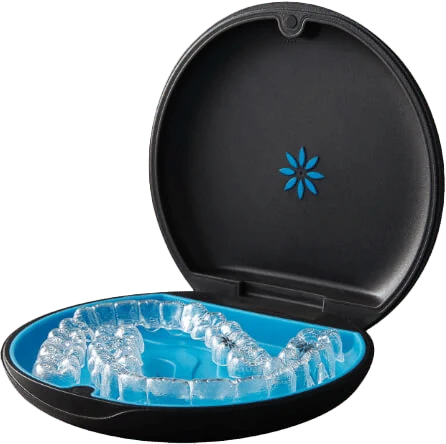
Invisalign clear aligners in a black storage case
Invisalign clear aligners

A first step in understanding treatment

Read the treatment principles first

Reading first about how the jaw joint and teeth are connected helps you understand why the condition of the jaw joint is considered in the orthodontic plan.

Why the Jaw Joint Matters
  1. 01Assessed together before orthodontics

    We check the dental arches, jaw structure, bite and jaw joint together.

    Details
  2. 02Starting from the adjusted jaw position

    Even with the same clear aligners, the plan differs depending on the position in which the impression is taken.

    Details
  3. 03Treatment sequence by goal

    We look at the paths leading from jaw joint treatment to orthodontics and on to maintenance.

    Details

Same aligner. Different starting position.

Even with the same clear aligners,
the plan differs if the starting position differs

An orthodontic plan starts from the position in which the impression of the mouth is taken.
If the center of the jaw and the dental midline do not match, it may have begun with misalignment of the skull,
so we look at the two together.
Press the buttons to compare.

Front-view diagramStarting position · Where you bite now
Center of the face and skull Upper jaw Center of the jaw Lower jaw Upper dental midline Dental midlines do not match
Center of the face and skull
Reference
Upper and lower dental midlines
Do not match
Center of the jaw (chin)
Off to one side

If the jaw is off to one side, the lower dental midline is off with it. The center of the face, the center of the jaw and the dental midlines appear out of line with each other.

This is a diagram to aid understanding and is not to actual size or scale. Your actual jaw position and midlines are checked after an examination.

The house-on-sand analogy

How do starting points A and B differ?

If jaw position is the ground, the teeth are the house built on it.

A
Where the teeth fit bestThe house is built with the ground left as it is
Position for the impression

Where you habitually bite down now

Reference

Where the teeth make the most contact

If the jaw is off to one side

That off-center position becomes the reference, unchanged

Even when the teeth are set straight, the jaw that serves as the reference remains tilted.

B
The MCB positionThe ground is prepared first, then the house is built
Position for the impression

The jaw position found to be comfortable for the skull

Reference

The position where the bones move in balance: the sphenoid for the lower jaw’s side-to-side position, the temporal bones for front to back and the occipital bone for height Dr. Lee’s clinical reference

If the jaw is off to one side

We plan to set the jaw in position first, then bring the molars that are not touching into even support

The jaw position is stabilized first, and the teeth are aligned on top of it.

This explains how the starting point of the plan differs. Treatment results vary from person to person.

Dr. Jinhaeng Lee

“Orthodontics is not only about moving teeth. It is about looking at function and balance too.”

Dr. Jinhaeng Lee · GSB Orthodontics

Treatment process

After an examination, we proceed according to your treatment goal

Jaw joint treatment only

  1. Examination and diagnosis
  2. MCB treatment
  3. Fine Bite Adjustment
  4. Making the MCB T/L Thermo splintFor maintenance

Jaw joint treatment followed by Invisalign

  1. Examination and diagnosis
  2. MCB treatmentAt least 250 sessions
  3. Invisalign
  4. Fine Bite Adjustment
  5. Making the MCB T/L Thermo splintFor maintenance

When MCB splint treatment is difficult at present

  1. Examination and diagnosis
  2. 20–30 sessions of MCB treatmentOptional · recommended
  3. Fine Bite Adjustment
  4. Making the MCB T/L Thermo splintTo prevent worsening

The figure of 250 sessions is our clinic’s guideline for proceeding to Invisalign after jaw joint treatment. Elementary school children may, depending on the diagnosis, begin orthodontic treatment after 150 sessions.

Orthodontics and jaw joint function

We assess not only tooth alignment
but also the bite and the jaw joint

Orthodontic treatment is dental treatment that improves tooth alignment and the bite relationship.

When planning orthodontic treatment, GSB Orthodontics checks the position of the teeth, the skeletal relationship of the jaws, bite contacts and the condition of the jaw joint together.

  1. 01

    Invisalign Clear Aligners

    Clear aligners are used to adjust the position of the teeth in stages.

    Whether it is suitable and how long treatment takes depend on the type of malocclusion, the difficulty of the tooth movement, oral health and other factors.

  2. 02

    Facial asymmetry and the bite

    Facial asymmetry can involve a combination of skeletal, dental, soft-tissue and functional factors.

    When assessing, a functional shift of the jaw joint needs to be distinguished from true skeletal asymmetry.

    Depending on the degree of skeletal asymmetry, there are limits to how much can be improved by orthodontic treatment alone.

  3. 03

    MARPE rapid maxillary expansion

    In some patients whose upper jaw is too narrow, a miniscrew-assisted maxillary expansion appliance may be considered.

    The treatment plan is decided with skeletal maturity, the structure of the palate and periodontal condition taken into account.

  4. 04

    Lower jaw position and the orthodontic plan

    Even when the lower jaw appears to sit back, it is important to distinguish skeletal factors from a functional change in position.

    Where needed, we observe lower jaw movement and the repeatability of the bite, and reassess the goals and scope of orthodontic treatment.

    Depending on the patient’s diagnosis, jaw joint treatment and orthodontic treatment can be carried out independently or in coordination.

Fees not covered by insurance

Invisalign treatment fees

Orthodontic treatment takes 1–3 years, depending on how consistently the aligners are worn and how quickly the teeth move.

If you would like orthodontic treatment after your jaw position has changed

When the jaw position changes, the place where the teeth meet changes too. At our clinic, we first stabilize the jaw position with the MCB splint, then plan Invisalign treatment around that position.

We provide Invisalign treatment only for patients who have had at least 250 sessions of MCB splint treatment. As an exception, elementary school children may start after at least 150 sessions.

Invisalign fees
ItemFee
Orthodontic diagnosis₩200,000
Omnivac (temporary retainer)For retreatment cases with an existing fixed retainer₩300,000
Invisalign treatment Visits every 3 months requiredSingle payment · interest-free card installments available · fixed retainer included₩5,800,000
Monthly care feeCharged every month even if you visit once every 2–3 months.₩70,000 per month
Miniscrew (temporary anchorage device)If used₩50,000 each
Removable retainerUsed after orthodontic treatment ends. The fixed retainer is included in the treatment fee.₩600,000–1,000,000
MCB splint course before orthodontic treatment
ItemUnitFeeValid for
MCB splint course ①145 sessions in total₩5,200,0003 months
MCB splint course ②112 sessions in total₩4,000,0001 yearWe recommend using it within 3–6 months
Temporomandibular disorder (TMD) assessmentOnce, at the first visitAbout ₩40,000-
Physical therapyPer follow-up visitAbout ₩13,000–17,000-

· Course ① must be used within its 3-month validity period. Sessions not used within that period expire.

· Course ② is valid for 1 year. We recommend using it within 3–6 months.

· Examination and physical therapy fees are separate from the course fee and may vary depending on whether national health insurance applies.

The fees above are for services not covered by Korean national health insurance and are listed as of October 2026. The total cost may vary with the condition of your teeth and the length of treatment, and after diagnosis we tell you your individual cost before treatment begins. The length and results of orthodontic treatment vary from person to person, and side effects such as tooth sensitivity, gum discomfort and root resorption can occur.

Before orthodontics, check where your jaw should be

At your first visit, we start with a temporomandibular disorder (TMD) assessment to look at jaw position and the bite. Whether orthodontics is needed is decided together after that.

Book a Consultation Call Us +82-2-3661-2211