

Teeth Grinding · Clenching

Do you clench your teeth without realizing it,
and grind them at night?

It may be more than a sleep habit.
It may be a signal from the brain trying to protect the airway and the bite.

When strong forces act on the teeth again and again during sleep, the teeth can wear down, the jaw can hurt, and the neck and shoulders can feel stiff. Our clinic looks for small bite interferences and soft-tissue irritation and, where needed, may combine fine bite adjustment with custom splint treatment.

Book a Consultation ↗
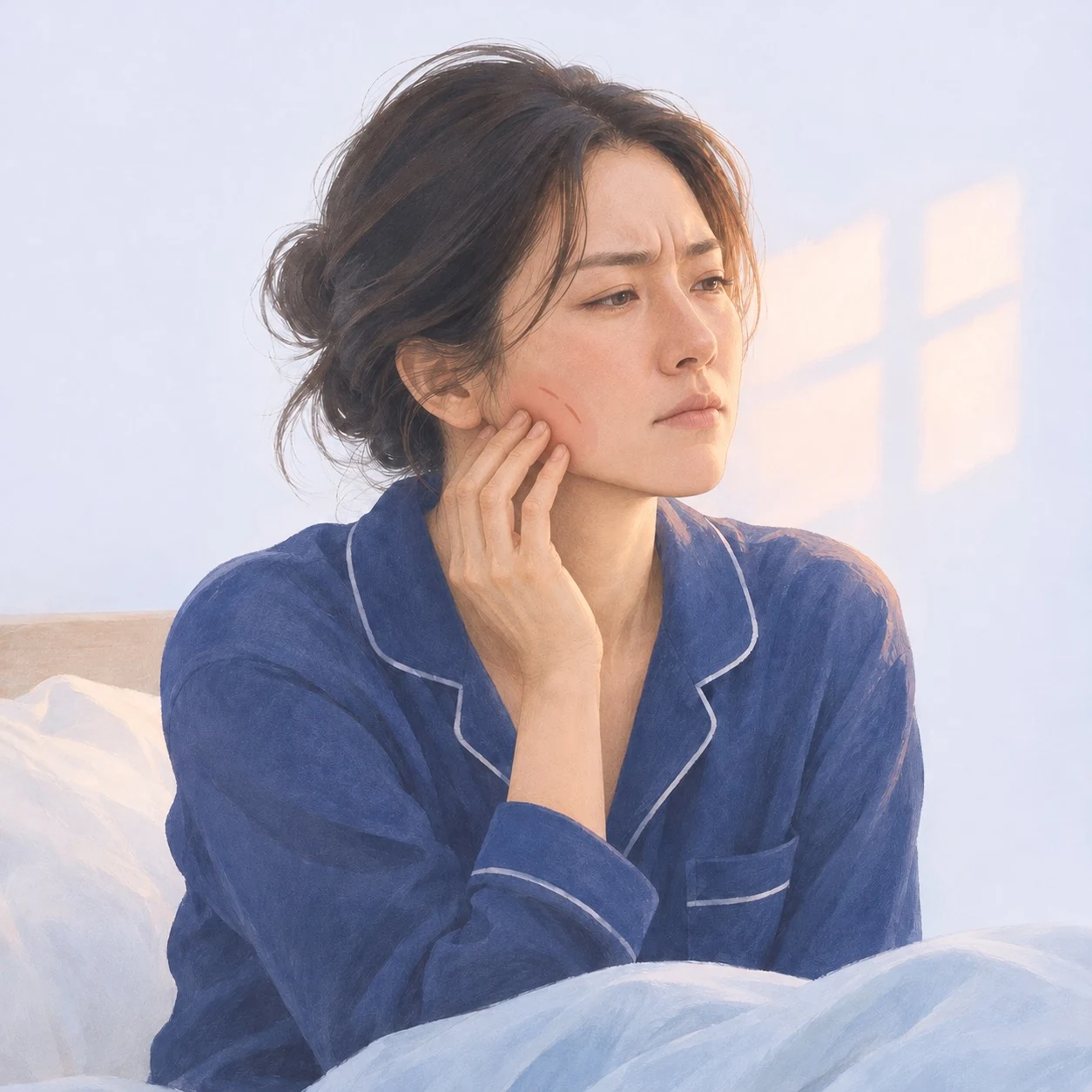
A person touching tense jaw muscles with their fingertips after clenching in the morning

01 · Symptom Check

From silent clenching to grinding during sleep,
strain can build up in the jaw

The force on the teeth during ordinary chewing varies from person to person but may be around 10–20 kg. When you clench or grind without realizing it, pressure 5–10 times greater, reaching 100 kg or more, can strain the jaw joint and head. If any of the items below apply to you, a detailed examination may be needed.

  • Right after waking (night symptoms)

    When you wake in the morning, both cheeks (masseter) or temples (temporalis) may feel stiff, or you may have a migraine.

  • During the day (daytime symptoms)

    When you concentrate on a screen or drive, lift something heavy or feel tense, you may clench your upper and lower teeth without noticing.

  • Signs inside the mouth

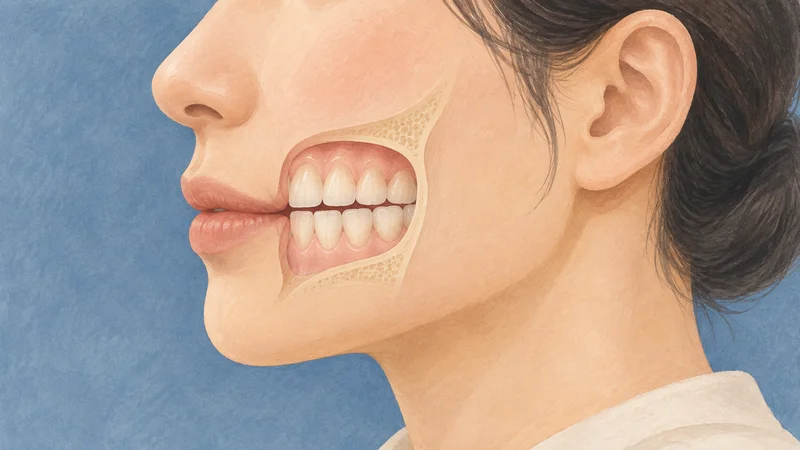
    The biting surfaces of the molars and canines may be worn flat and sensitive to cold water, and clear tooth marks may be left along the edge of the tongue or the inside of the cheek.

  • Whole-body fatigue

    Even after enough sleep, the neck, shoulders and trapezius may feel rock-hard and knotted, and you may feel completely drained.

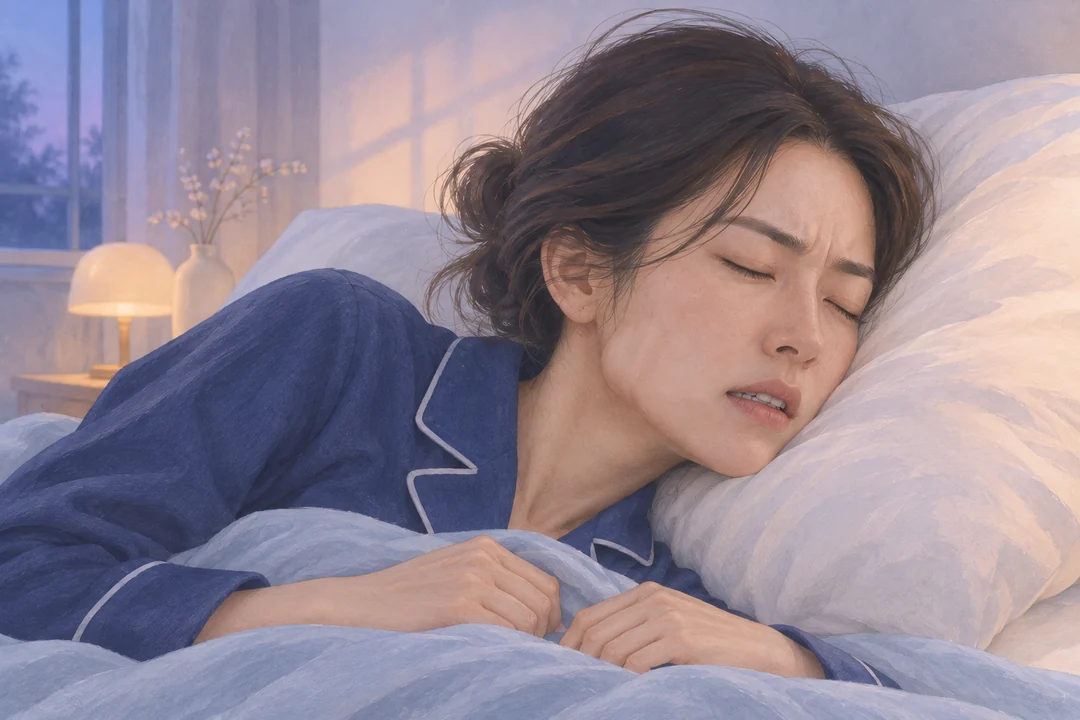
A person grinding their teeth while asleep
Grinding during sleep
A person frowning and clenching their teeth at a computer
Clenching during the day

02 · Causes

Stress and tension by day, keeping the airway open by night:
why the brain may tighten the jaw

Many people dismiss teeth grinding and clenching as just a sleep habit or tiredness.
From an oral medicine and structural point of view, however, it may be the combined result of sympathetic nervous system tension during the day and a reflex of the brain trying to relieve restricted breathing at night.

  1. At nightA reflex of the brain to keep the airway open

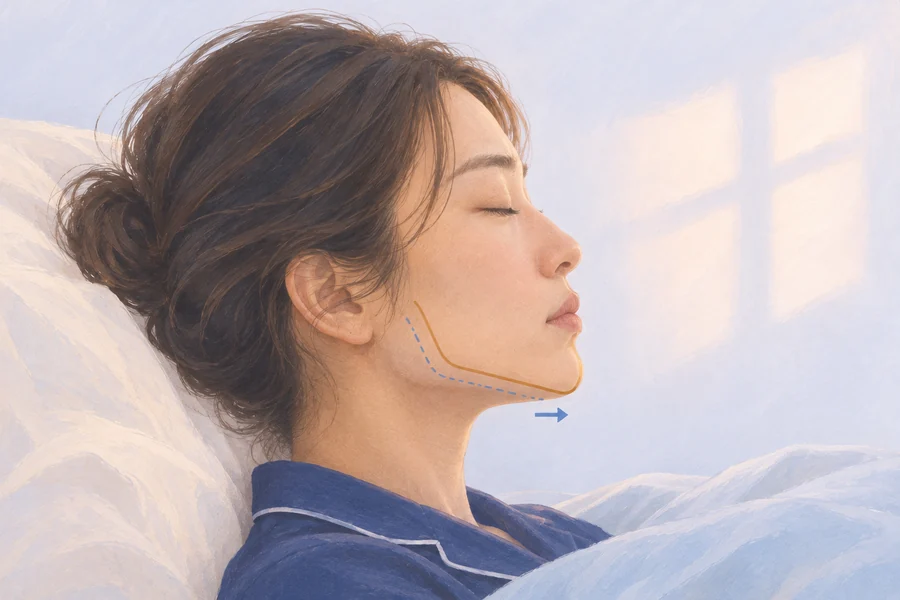
    When muscle tone drops during sleep and the lower jaw and the base of the tongue move back, the airway can narrow. At the point where breathing becomes difficult, the jaw muscles (masseter and temporalis) become active, and in the process the teeth may come together or grind.

  2. During the dayTension from concentration and stress

    When you are absorbed in work or driving, or under tension or stress, the sympathetic nervous system becomes active and you may clench your upper and lower teeth without noticing. When teeth that should normally be apart stay in contact under strong, repeated force, chronic fatigue can build up in the jaw muscles, neck and shoulders.

  3. Common factorsTiny premature contacts and soft-tissue irritation

    When teeth bump against each other at a point no thicker than a single hair (0.01 mm), or a tooth edge worn sharp keeps irritating the tongue and cheek lining, the trigeminal nerve, which carries sensation, can become overly sensitive. As the brain reacts by trying to avoid or grind away this uncomfortable stimulus, the jaw muscles may tighten and you may clench, day or night.

03 · Problems That Can Develop

Beyond tooth wear, it can affect the jaw joint,
muscles throughout the body and breathing during sleep

If 100 kg of pressure, like two adult men standing on the teeth, and nerve irritation inside the mouth are left unaddressed, they can set off a chain of problems that reaches beyond the mouth to overall health.

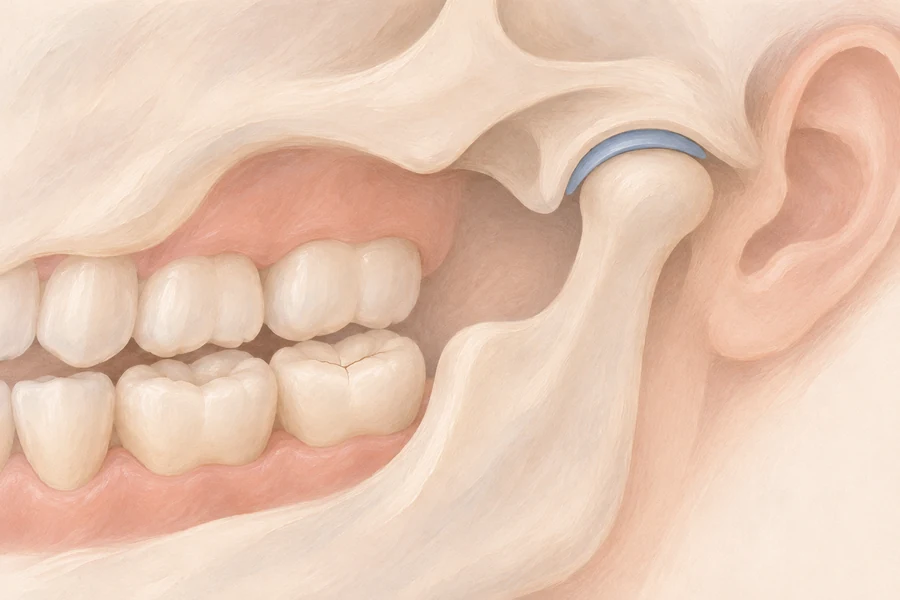
Diagram showing the surface of a molar and the position of the jaw joint in front of the ear

① Tooth wear, hairline cracks and damage to the jaw joint disc

Repeated excessive biting force can wear down the molars and canines and cause fine cracks, invisible to the eye, across the teeth, so that they become very sensitive to cold water or fracture. At the same time, the force of biting with the jaw twisted can narrow the joint space, compressing and damaging the jaw joint disc.
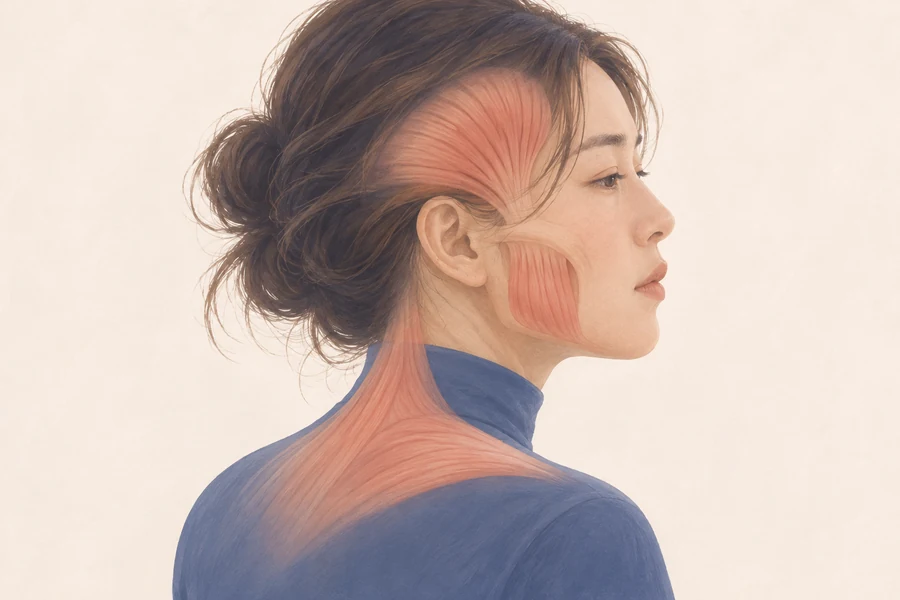
Drawing marking the muscles running from the jaw and temple and from the back of the neck to the shoulder

② Muscle fatigue spreading to the neck, shoulders and trapezius

Strong tension arising in the jaw muscles (masseter and temporalis) can spread to the connected neck, shoulders and back (around the trapezius and shoulder blades). It is as if the muscles had worked against 100 kg all night, so even after sleeping you may still have migraines and a chronic fatigue that feels as though the muscles are drained of energy.

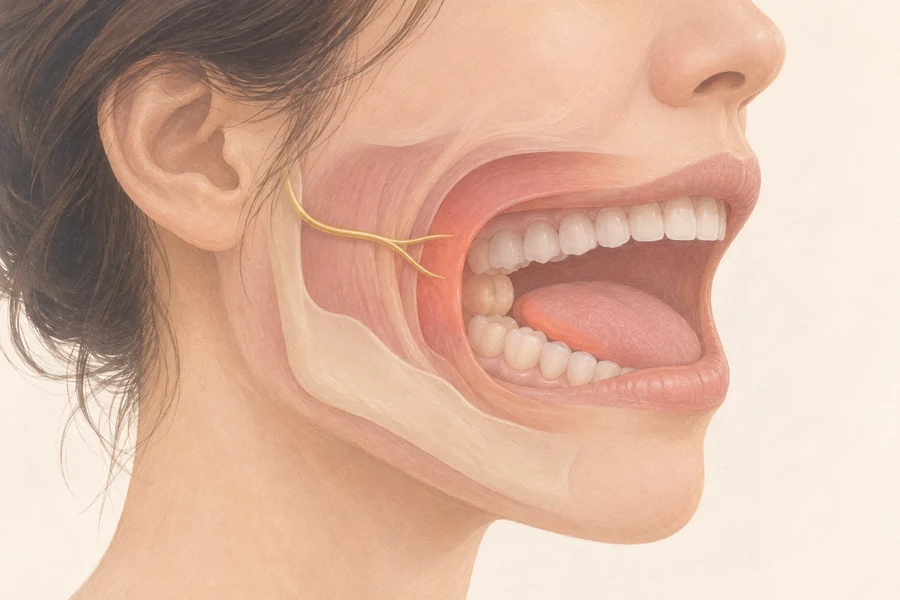
Simplified diagram of the lining of the cheek and the edge of the tongue, and the sensory nerves of the mouth

③ Abnormal pressure on the soft tissue and whole-body imbalance

Abnormal pressure on the gums and the inside of the cheeks can stimulate the brainstem through the trigeminal nerve and set off a chain of reactions in the body. At our clinic, we also consider the possibility that pressure on the soft tissue of the upper jaw (maxilla) appears together with tension in the upper chest, and pressure on the soft tissue of the lower jaw (mandible) together with tension in the abdomen, pelvis and legs.

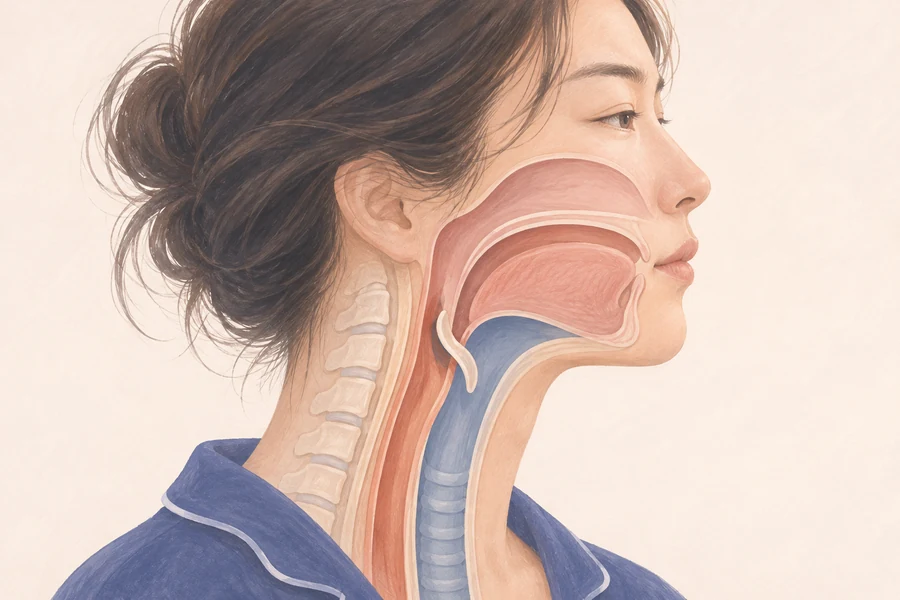
Diagram comparing the positions of the airway and esophagus in a side cross-section of the neck

④ Reduced normal swallowing and the risk of micro-aspiration at night

When the lower jaw is pushed back during sleep and the airway narrows, it can lead to mouth breathing, which increases harmful bacteria in the mouth, and the normal swallowing function that safely carries saliva down the esophagus during sleep can also decline. As a result, silent micro-aspiration at night, in which saliva mixed with bacteria or stomach acid flows into the airway without a cough reflex, can occur repeatedly, and this can be a factor that raises the risk of aspiration pneumonia in middle-aged and older adults.

About sleep apnea and snoring ↗

04 · Limits of Conventional Approaches

Reducing muscle force alone, or simply covering the teeth, can leave the underlying cause in place

These approaches may help with temporary relief, but the structural causes and nerve irritation that make you clench and grind can remain.

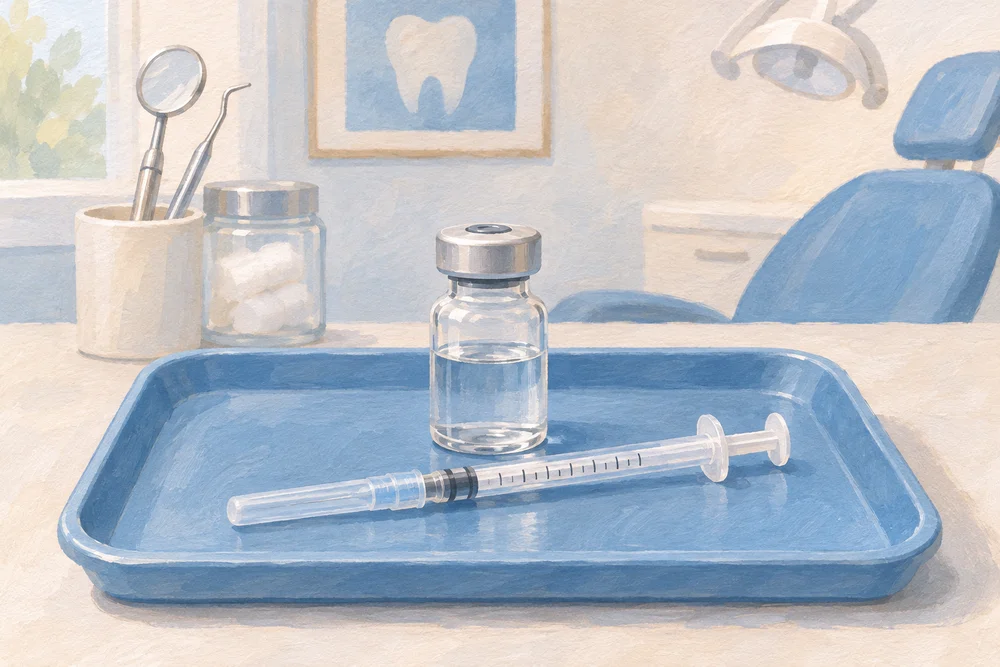
Limits of jaw Botox

Illustration of a vial and syringe representing jaw Botox

Botox injected into the jaw muscles can temporarily weaken biting force and reduce grinding noise. However, the brain’s reflex to move the jaw forward to open a narrowed airway, and a 0.01 mm bite interference, can remain. When the effect wears off, grinding may return, or it may become harder to keep the airway open during sleep and other nearby muscles may become overactive instead.

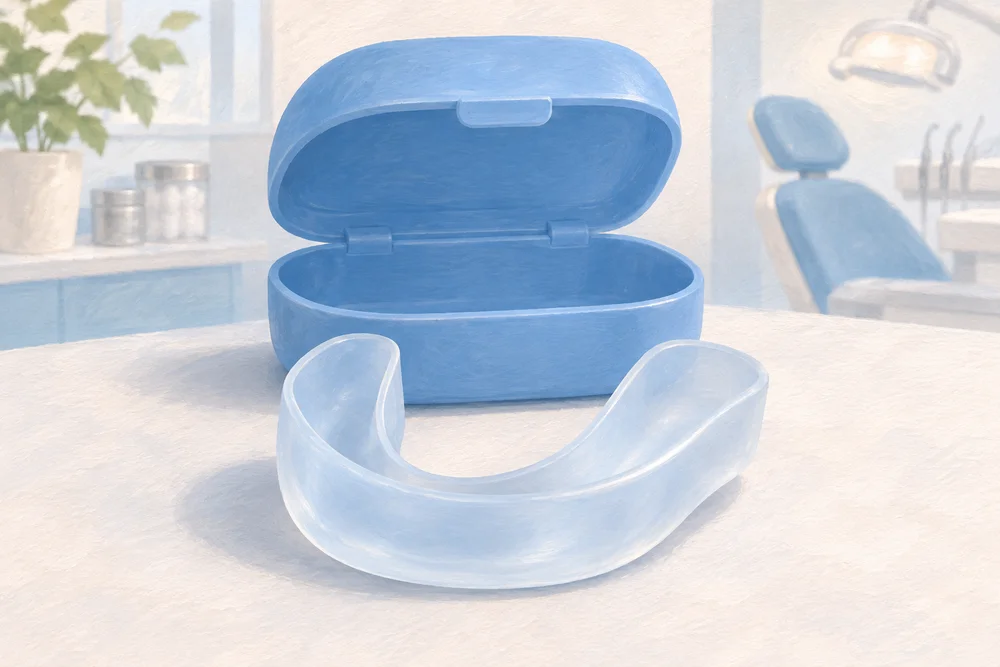
Limits of ready-made mouthguards

Illustration of a smooth U-shaped ready-made mouthguard and its storage case

Low-cost ready-made appliances sold in stores may not adequately reflect an individual’s bite or the central axis of the jaw joints. If a thick ready-made appliance is worn while the physical cause and nerve irritation remain unresolved, the bite may shift and the jaw joint disc may be compressed further.

05 · Treatment at Our Clinic

Two treatment plans to fit your visit schedule

We assess where the teeth meet and how the jaw moves.
We choose an appliance based on those findings and on whether long-term visits are possible, and may combine it with fine bite adjustment as needed.

If long-term treatment is possible

Custom MCB Splint

+ Fine Bite Adjustment

MCB-H · For in-clinic treatment
MCB-L · For sleep

We make an MCB splint to match your jaw position and tooth contacts. At regular visits, we check jaw movement and changes in the bite after you wear it and continue with any adjustments needed.

More about custom MCB treatment ↗

If long-term treatment is difficult right now

Thermo Splint

+ Fine Bite Adjustment

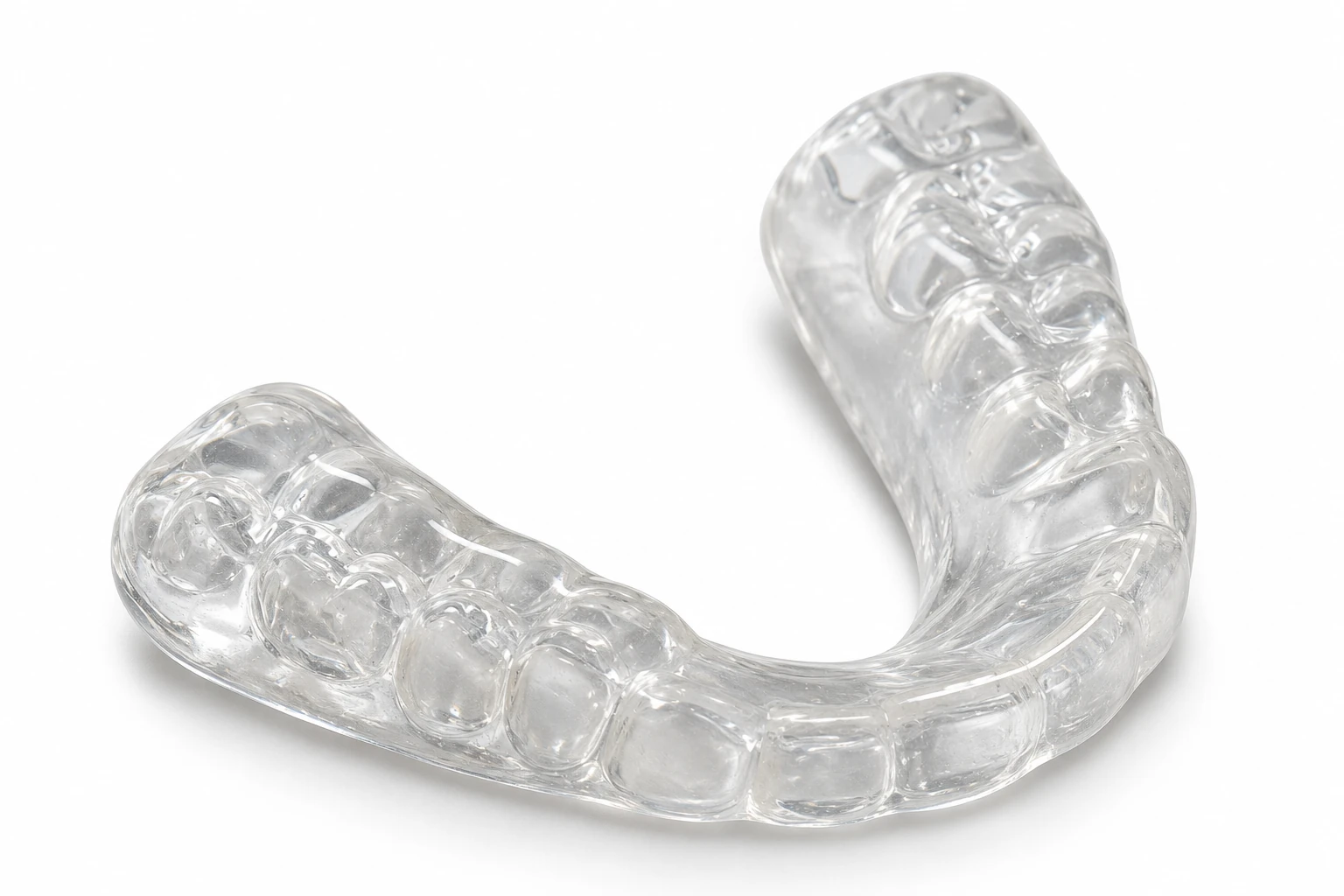
Clear thermoplastic Thermo splint

We make a thermoplastic Thermo splint to fit the shape of your teeth. We explain how long to wear it and what to watch for during use, and set the next checkup around your availability.

More about the Thermo splint ↗

06 · Everyday Habits

A resting-jaw habit to relax the jaw during the day

  1. A relaxed jaw with the upper and lower teeth slightly apart

    Keep your upper and lower teeth slightly apart

    When you are focused on a screen or lifting something heavy, check from time to time that you are not clenching your teeth, and let your jaw relax.

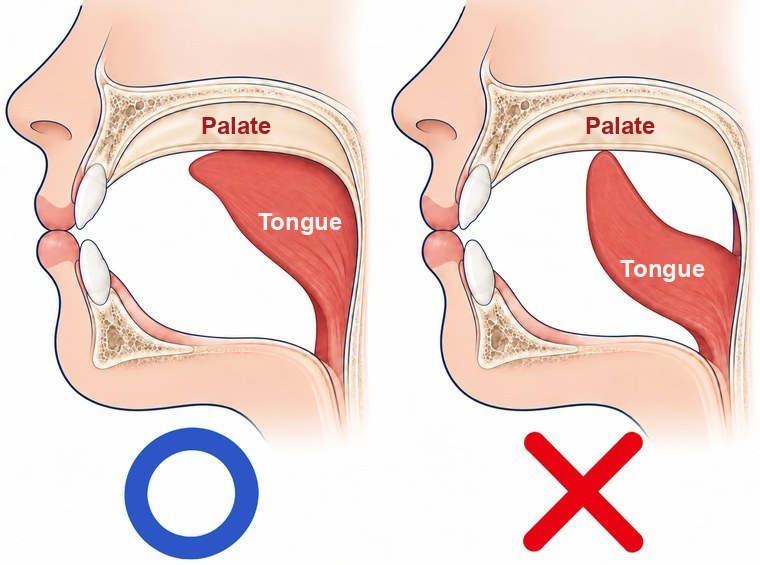
  2. Drawing comparing the tongue touching the front of the roof of the mouth and the tongue curled back

    Rest your whole tongue against the roof of your mouth

    Place your tongue so that it touches the whole roof of your mouth, starting about 2 cm behind the front teeth, and keep it there for as long as you can.

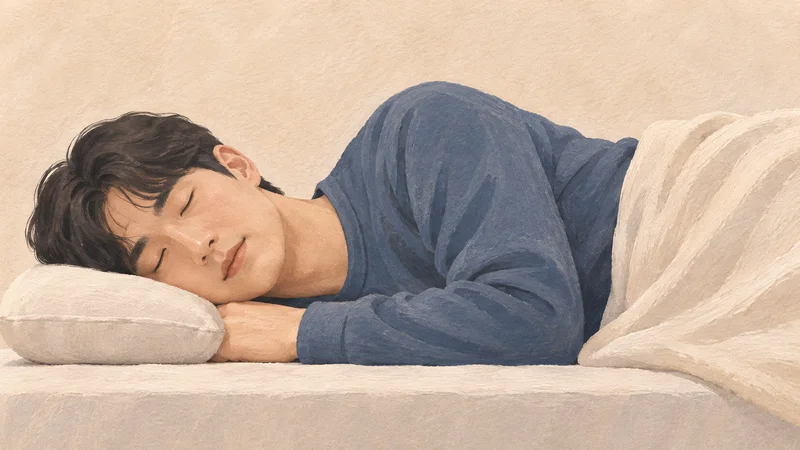
  3. A pillow comfortably supporting the head and neck when lying on one side

    Check your sleeping position and pillow height

    When you lie down, check that the pillow is a comfortable height and your neck is not sharply bent. If pauses in breathing keep occurring regardless of position, it is a good idea to have your sleep assessed.

  4. A warm towel resting lightly around the jaw in front of the ear

    Warm compress around the jaw before bed

    If your jaw muscles feel stiff, try resting a warm towel lightly on both sides of the jaw and the temples for about 10 minutes before you go to sleep.

Book a Consultation Call Us +82-2-3661-2211